The 2026 Summer of Work is a voluntary placement initiative intended to provide a work placement experience comparable to an industry placement. The initiative aims to address the shortfall in placement options that has been caused by the economic downturn. The experience being offered here is on a project that is vital to New Zealand's prosperity as the provision of nutrients to agricultural activity underpins the ongoing productivity of our land. Providing fertilizer in a sustainable manner through the innovation of recovering nutrients from the biosphere will put New Zealand at the forefront of the circular economy in an area yet to be explored to its full potential. The project you will work on involves the electrocatalytic conversion of Ionic NOX to ammonia.
Half of the world’s food production is made possible through fertilizers.
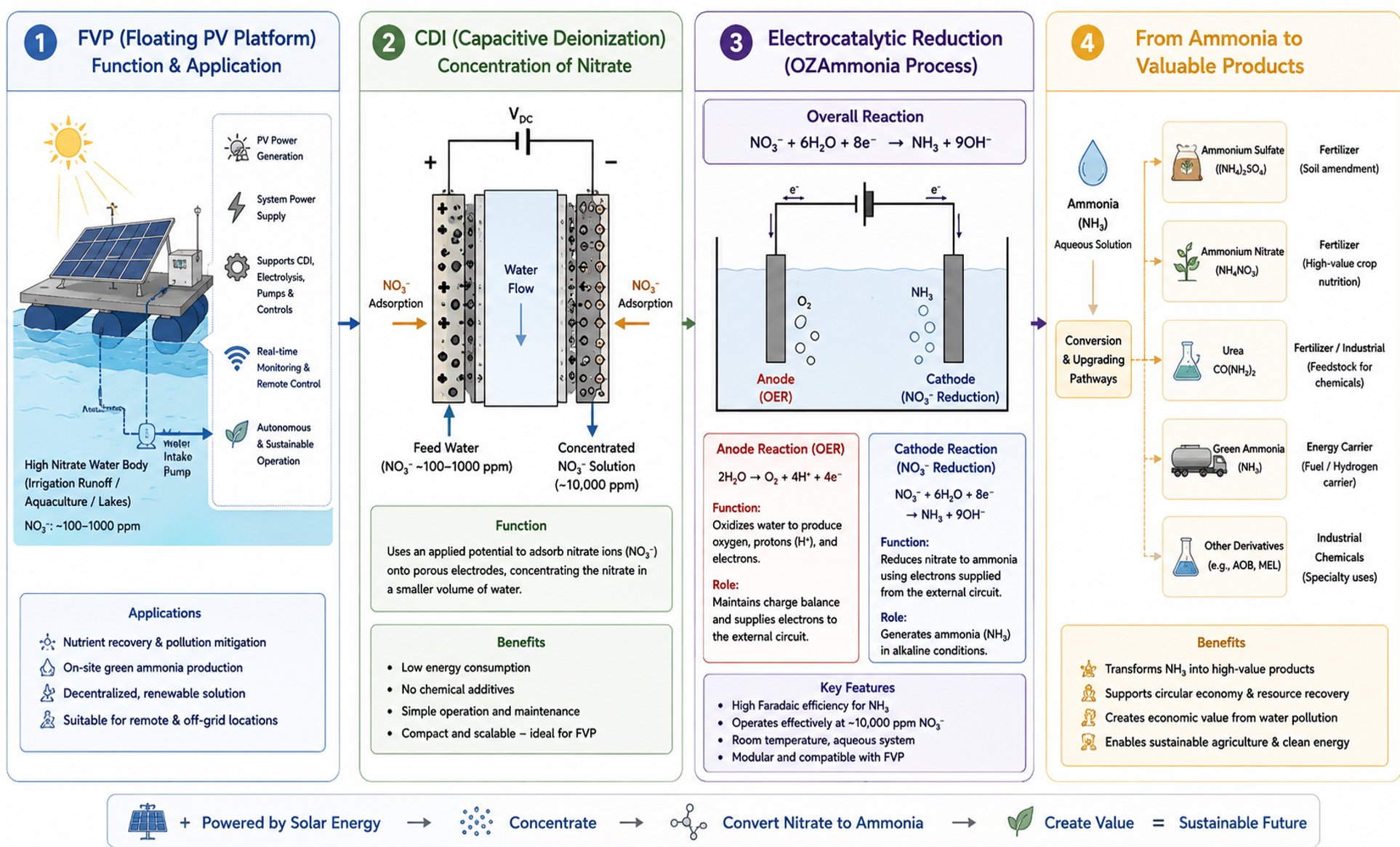
Currently NZ faces a fertilizer import (~$495M-USD) dependency issue arising from feedstock shortage due to depletion of natural gas reserves. Electrocatalytic production of ammonia fertilizer uses ionic NOX as the starting point (NO2-, NO3-) as opposed to nitrogen via the traditional Haber Bosch process that has been used for the last 100 years. Ionic NOX can be produced from irrigation/farm run-off water, present at 100-1000PPM. The required feed concentration for efficient production of electrocatalytic ammonia is in the range of 2000PPM to 5000PPM and above. Thus, there is an opportunity for a novel process for concentrating Ionic NOX by a factor of 5-10 to enable the production of ammonia fertilizer from low NOX level sources.
The proposed summer research project involves building a pilot scale demonstration of a photovoltaic floating platform containing an ionic NOX concentrating device based on the capacitive deionization (CDI) stack design recently published by our team. Recent trials conducted at the University of New South Wales in Sydney with UoW in collaboration with the OZAmmonia team demonstrated that our CDI stack could effectively concentrate low levels of ionic NOX up to the desired range compatible with a range of suitable catalyst.
The proposed future collaboration is a floating platform combining UoW, UNSW catalyst technology and Mincarb (fibreglass floating platform) to produce a decentralised solution to fertilizer production that has a minimal land footprint. The technoeconomic analysis would accelerate commercialisation of a novel idea that contributes to fertilizer security, reduces impact of fertilizer run-off on the environment, and catalyse early innovators to reduce the import dependency by up to $14.6M USD.
Teams
You will be working in multidisciplinary teams ranging from 3 to 6 people (with project managers) to construct and test the solar powered floating platform for extracting ionic NOX for conversion to ammonia fertilizer. The Redmine project management system will be used again based on the success we had with managing a team of 34 students in the 2020 COVID summer of work.
Roles
We are looking for enthusiastic participants for roles in the following teams:
•Electrode Production Team
•Fibreglass Floating Platform Fabrication Team
•Power Management and Solar Power Design
•Fluidics Team
•Scientific Team (Characterisation and Analytics)
Further Info
To apply to reserve a spot on the team, please go to the following link:
https://roles.mincarb.com/web/index.php/recruitmentApply/jobs.html
We are looking to process application over the June/July period for the November start. Stay tuned for further announcements.